PGYpal
PGYpal is a medical education app for residents preparing for board exams. The product had steady content usage but low engagement and weak retention.
Project Type
UX Design, UI Design
Collaborators
2 Designers, 1 Project Manager, 2 Developers, 2 QA
Duration
8 Weeks (April 2025)
Tools
Figma, Figjam

Research
Research Goals
• Understand why users were not engaging beyond passive content consumption.
• Identify barriers to collaboration within real study workflows.
• Determine whether collaboration features aligned with residents’ mental models and time constraints.
• Validate whether low engagement was driven by discoverability, trust, or perceived value.
Competitive Analysis

First, I conducted a heuristic evaluation against collaborative platforms such as Discord, Slack, and Reddit, focusing on:
• Visibility of activity and presence
• Social proof and engagement cues
• Low-friction participation patterns
This highlighted how PGYpal’s collaboration features lacked clear entry points and feedback loops compared to tools residents already used daily.
Product Analytics

Used to identify:
• Session length and drop-off patterns
• Feature usage frequency
• Entry and exit points during study sessions
This confirmed that users were in-and-out quickly, with minimal interaction beyond reading content.
Research Key Insights
Despite being visible, lightweight, and embedded within study flows, collaboration features were still rarely used. This indicated that the barrier to engagement was not discoverability or usability, but perceived value and social dynamics. Across research methods, several deeper insights emerged:
Users did not see immediate personal benefit in initiating collaboration
Residents prioritized efficient, individual progress. Collaborative actions were perceived as slowing momentum unless their value was explicit and immediate.
Low participation created a social “cold start” effect
Without visible peer activity, users were reluctant to be the first to comment or contribute, reinforcing inactivity over time.
Social risk outweighed potential learning benefits
Users were hesitant to expose uncertainty or ask questions publicly in a high-stakes academic environment.
Existing collaboration lacked clear outcomes or feedback loops
Users could interact, but it was unclear what would happen next—who would respond, when, or why it mattered.
Iterations and Testing
Iterations and Testing


• Translated behavioral research insights into multiple collaboration concepts focused on reducing social friction and increasing contextual engagement
• Explored several interaction patterns ranging from lightweight inline collaboration components to a dedicated full-screen collaboration experience
• Tested smaller embedded collaboration modules alongside more immersive collaboration modes to evaluate flexibility, discoverability, and usability across different study behaviors
Iterations and Testing Key Insights
• Full-screen collaboration experiences increased visibility but risked competing with the primary study workflow
• Inline collaboration created a better balance between focused studying and peer engagement
• Iterating across multiple collaboration models helped validate that participation depended more on perceived value and comfort than feature quantity
Final Designs
Study Channels

• Reorganized collaboration into topic-specific study channels to reduce ambiguity and improve contextual engagement
• Shifted discussions from broad social spaces to focused academic conversations aligned with real study workflows
• Lowered participation friction by leveraging familiar collaboration patterns inspired by Discord
• Improved discoverability and relevance of peer discussions within active study content
Voice Chat Rooms

• Reduced social friction by prioritizing audio participation over face-to-face interaction in high-pressure academic discussions
• Connected each voice chat directly to a dedicated study channel, reinforcing contextual and topic-focused collaboration
• Increased sense of peer presence and real-time engagement
Peer Visibility & Verified Presence

• Reduced uncertainty around audience visibility, helping users feel more comfortable engaging in collaborative discussions
• Enabled lightweight networking through quick-access user profiles connected directly to study participation
• Made collaboration feel more credible and active by surfacing visible peer presence within study workflows
Anonymous Comments
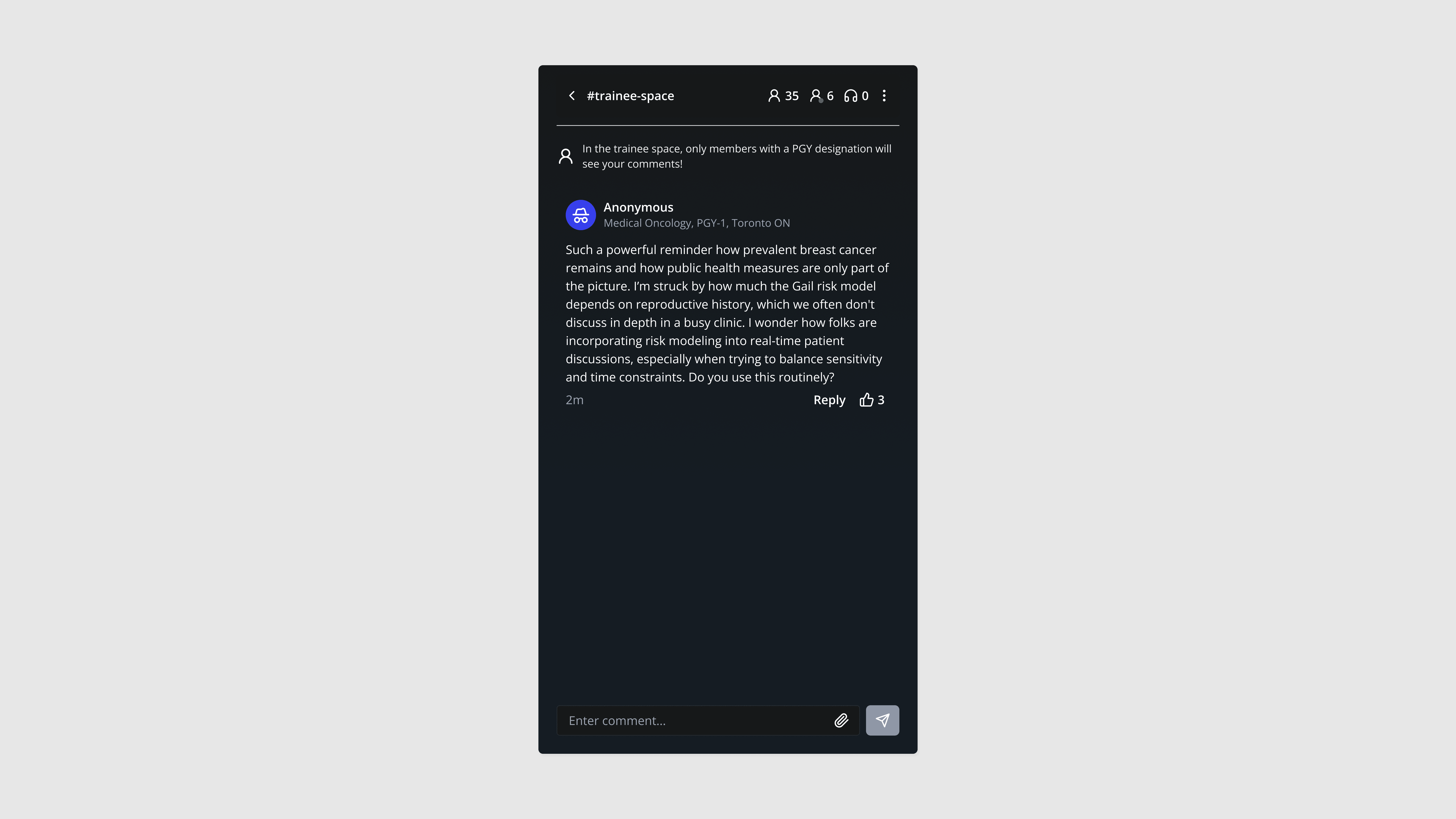
• Lowered the social barrier to engagement in a high-pressure academic environment where users feared judgment or appearing uninformed
• Encouraged early-stage participation from hesitant users who may otherwise remain passive observers
Study Intentions

